Recent Google Search Console Impression Emails: What’s Going On and Why You Can Relax
If you’ve had a strange email today from Google about impressions, don’t panic.
Over the past day or so, a lot of small business owners have received emails with the subject starting “Monitor the Google Search traffic to …” from Google saying that Google Search Console has started collecting Search impressions from the 12th of April. If that made you pause for a moment, you’re not alone. It’s the sort of message that sounds important, slightly technical, and just vague enough to make you wonder if something has changed with your website.
Let’s clear this up straight away. This is nothing to worry about.
In fact, Google has been collecting impression data for a very long time. This isn’t new, and it doesn’t mean your site has suddenly changed, stopped working, or lost visibility. What you’re seeing is almost certainly a small reporting issue or “blip” on Google’s side rather than anything you’ve done.
To give you some context, we’ve had several hundred of these emails come through this morning – literally one for each client. That alone tells you this isn’t a one-off issue. It’s widespread, and it’s affecting a lot of websites at the same time.
Our approach? We’re simply archiving the emails and taking no action.
In this article, we’ll explain what these emails mean, why they’ve appeared now, and what (if anything) you should do next. We’ll keep things simple, practical, and focused on what actually matters for your business.
What the Google Email Actually Says (and What It Means)
The wording of the email is what’s causing most of the confusion. It suggests that Google Search Console has only just started collecting impression data from the 12th of April. If that were true, it would be quite a big deal.
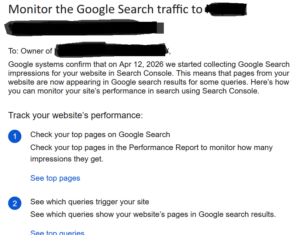
But here’s the key point: it isn’t true in the way it sounds.
Google Search Console has been tracking impressions for years. An impression simply means your website appeared in search results, whether someone clicked on it or not. It’s one of the most basic pieces of data in Search Console.
So when you see an email suggesting this has only just started, it understandably raises eyebrows.
What’s far more likely is that Google has had a hiccup in how it reports or labels this data. These things do happen. Google runs massive systems, and occasionally something doesn’t behave quite as expected.
The important thing to understand is that this kind of message doesn’t mean your website has suddenly started appearing in search results for the first time. It also doesn’t mean you were missing data before.
It’s simply a notification that doesn’t reflect reality very well.
If you want a clearer breakdown of what’s likely going on, we’ve covered it in more detail here: Google Search Console impression bug – what it means for your small business.
That page goes into the likely cause and why this looks very much like a reporting issue rather than a real change.
Why This Looks Like a Google “Blip”
When something changes across hundreds or thousands of websites at the same time, it’s usually a sign that the issue sits with the platform, not with individual sites.
That’s exactly what we’re seeing here.
We’ve had hundreds of identical emails land at the same time, each linked to a different website. These sites vary in size, industry, and setup, yet they’ve all received the same message.
That consistency is a big clue.
If this were a genuine change in how impressions are collected, you’d expect a proper announcement, clear documentation, and a gradual rollout. Instead, what we’ve got is a sudden wave of emails with slightly confusing wording.
This strongly suggests a temporary issue – perhaps a bug in how notifications are triggered or how data is labelled internally.
It’s also worth remembering that Google regularly updates and tweaks its systems. Most of the time, these changes go unnoticed. Occasionally, something like this slips through and causes confusion.
From experience, these situations usually resolve themselves fairly quickly. The data in Search Console continues as normal, and the emails stop once Google corrects whatever caused the problem.
If you’re used to keeping an eye on your Search Console data, you’ll likely notice that nothing dramatic has changed. Your impressions, clicks, and positions will continue to behave as they did before.
For a better understanding of how Search Console normally works, you might find this helpful: what is Google Search Console.
It explains the basics and helps put messages like this into context.
What We’re Doing (and Why We’re Not Taking Action)
Whenever something unusual like this happens, the first instinct is often to act. Check everything, make changes, try to “fix” the issue.
In this case, that’s not necessary.
As mentioned earlier, we’ve received several hundred of these emails across our client base. Rather than reacting to each one individually, we’ve taken a step back and looked at the bigger picture.
There’s no sign of ranking drops. No sudden changes in traffic. No indication that websites have stopped appearing in search results.
So our response is simple: archive the emails and carry on as normal.
This approach is based on experience. Over the years, we’ve seen similar situations where Google sends out confusing or misleading notifications. In almost every case, they turn out to be temporary and harmless.
Taking action without a clear problem can sometimes do more harm than good. You might end up changing things that were working perfectly well.
Instead, it’s better to focus on the fundamentals. Is your website working? Are people still finding you? Are enquiries coming in?
If the answer to those questions is yes, then there’s no reason to worry.
For more practical advice on using Search Console without getting overwhelmed, you might want to read how to use Google Search Console for SEO.
It focuses on what actually matters, rather than getting lost in every notification.
What You Should Do (Spoiler: Not Much)
So where does this leave you as a small business owner?
In simple terms: you don’t need to do anything.
You don’t need to update your website. You don’t need to change your SEO strategy. You don’t need to contact Google.
The best thing you can do is stay calm and carry on focusing on the areas that actually impact your business.
That means keeping your website up to date, making sure your content is clear and useful, and continuing to target the kinds of searches your customers are making.
It’s also a good reminder not to rely too heavily on individual alerts or notifications. Tools like Search Console are useful, but they’re not perfect. Sometimes they send messages that don’t quite reflect what’s really happening.
What matters more is the overall trend. Are things improving over time? Are you getting more visibility, more clicks, more enquiries?
If you want to build a stronger foundation, it’s worth looking at broader guidance like basic SEO tips for small businesses, which covers the essentials in a straightforward way.
That kind of steady, consistent approach will always deliver better results than reacting to every unexpected email.
Final Thoughts: Keep Things in Perspective
It’s easy to feel unsettled when you get a message from Google that doesn’t quite make sense. After all, your website is important to your business, and anything that looks like a change can feel like a potential problem.
But in this case, there’s no need for concern.
The email about Search Console starting to collect impressions from the 12th of April is almost certainly something that relates to a fix at Google’s end that for some reason has triggered a “we’ve started” email. It doesn’t reflect a real change in how your website performs, and it doesn’t require any action on your part.
The fact that so many of these emails have been sent at once only reinforces that point. This isn’t about your site – it’s about something happening at Google’s end.
So the best thing you can do is keep things in perspective. Focus on your customers, your content, and your overall online presence.
Those are the things that drive real results.
Everything else – including the occasional confusing email – is just background noise.
About the Author
John K Mitchell has been optimising websites for search engines since 1997, before Google even existed. With a background in programming, he began analysing search results early on to understand – or at least make informed guesses about – why websites ranked where they did.
Since then, he has worked on thousands of websites across a wide range of industries, helping businesses improve their visibility and attract more customers online. His approach focuses on practical results and long-term consistency rather than reacting to short-term changes or trends.